Migration to SAP S/4HANA in 2026: A Practical Guide to Preparing Your Company Without Risks

Introduction
For many companies, migrating from SAP ECC to SAP S/4HANA is no longer simply an IT upgrade. It is a major business transformation that affects finance, procurement, sales, supply chain, manufacturing, human resources, data, integrations, and business processes.
In 2026, organizations that are still running SAP ERP/ECC should have a clear migration strategy. SAP has announced mainstream maintenance for SAP Business Suite 7 core applications until the end of 2027, followed by optional extended maintenance until the end of 2030. At the same time, SAP has committed to maintaining SAP S/4HANA innovation through 2040.
Therefore, the key question is no longer:
“Should we migrate to SAP S/4HANA?”
The more important question is:
“How can we migrate to SAP S/4HANA while minimizing business, technical, financial, and operational risks?”
1. Understand Why the Migration Is Necessary
SAP S/4HANA represents a significant evolution of the traditional SAP ERP environment.
The transformation provides organizations with opportunities to:
Simplify business processes
Improve real-time reporting and analytics
Modernize the user experience with SAP Fiori
Reduce technical complexity
Take advantage of the SAP HANA database
Improve integration capabilities
Automate repetitive activities
Adopt cloud technologies
Prepare for AI-enabled business processes
Establish a foundation for future SAP innovations
However, migration should not be driven only by the end of SAP ECC maintenance.
The objective should be to create a better, simpler, and more future-ready business environment.
2. Assess Your Current SAP Landscape
Before starting a migration project, the company must understand its current environment.
A complete assessment should cover:
Technical landscape
Analyze:
SAP ECC version
Enhancement packages
SAP NetWeaver version
Database
Operating system
SAP kernel
SAP interfaces
SAP add-ons
Third-party applications
Custom developments
Background jobs
Interfaces and middleware
This assessment helps determine whether the current system is technically ready for conversion.
SAP documentation also recommends checking the source system and supported migration scenarios before using migration tools such as the SAP S/4HANA Migration Cockpit.
3. Analyze Custom Code
One of the biggest risks in an SAP S/4HANA migration is custom development.
Many SAP ECC systems have accumulated years of:
Z programs
User exits
BAdIs
Enhancements
Custom tables
Custom reports
Interfaces
Forms
Workflows
Not every custom object should automatically be migrated.
The organization should classify custom developments into three categories:
Keep
The development is still required and provides real business value.
Replace
SAP S/4HANA already provides standard functionality that can replace the custom solution.
Retire
The development is obsolete and should be removed.
This approach supports the Clean Core strategy and helps reduce technical debt.
4. Choose the Right Migration Approach
One of the most important strategic decisions is selecting the migration approach.
There are three major approaches:
Greenfield Implementation
The company implements SAP S/4HANA as a new system.
This approach is appropriate when the organization wants to redesign its processes and eliminate unnecessary legacy complexity.
Advantages:
Clean system
Standardized processes
Opportunity for business transformation
Reduced legacy customization
Challenges:
Larger organizational change
More business process redesign
Data migration complexity
Higher change-management requirement
Brownfield Conversion
The existing SAP ECC system is converted to SAP S/4HANA.
This approach allows organizations to preserve significant existing processes and data while moving to the new platform.
Advantages:
Existing business processes can largely be preserved
Historical data remains available
Faster transition in many scenarios
Lower organizational disruption
Challenges:
Legacy customizations
Data quality problems
Existing process inefficiencies
Compatibility issues
Technical debt
Selective Data Transition
This approach combines elements of greenfield and brownfield.
The organization selectively transfers:
Master data
Historical data
Open transactions
Selected business processes
Selected organizational structures
This can be useful for companies that need a transformation but cannot completely abandon their existing SAP environment.
5. Prepare Master Data
Data quality is one of the most important factors in migration success.
Poor-quality data can create serious problems after go-live.
The preparation should include:
Customer Master Data
Duplicate customers
Incomplete addresses
Incorrect payment terms
Invalid tax information
Vendor / Supplier Master Data
Duplicate suppliers
Missing purchasing information
Incorrect payment terms
Invalid bank information
Material Master Data
Duplicate materials
Incorrect units of measure
Missing purchasing data
Incorrect valuation data
Inconsistent descriptions
Financial Data
Open items
General ledger balances
Asset information
Cost centers
Profit centers
The objective should be:
Clean data → Transform data → Validate data → Migrate data
6. Focus on SAP MM and Procurement
For SAP MM consultants, migration to S/4HANA introduces important functional changes.
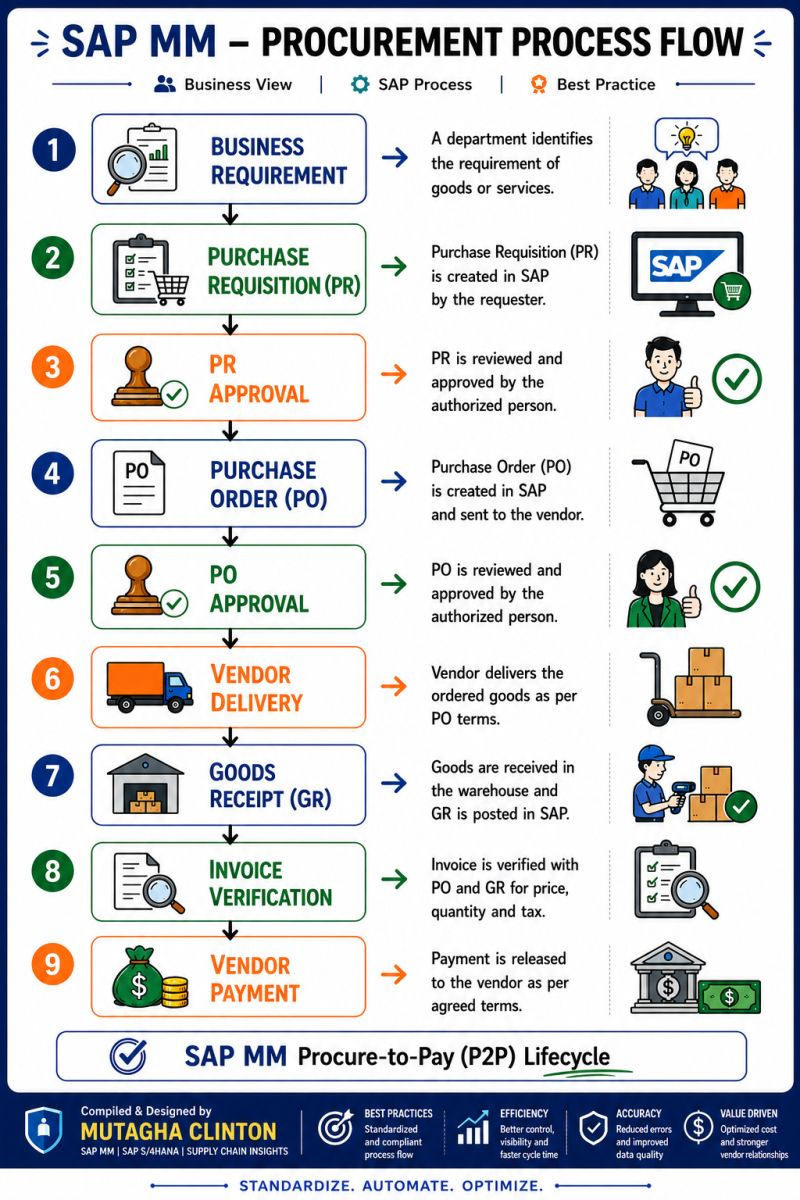
The procurement process should be reviewed from end to end:
Purchase Requisition → Purchase Order → Goods Receipt → Invoice Verification → Payment
The migration project should evaluate:
Purchasing organizations
Purchasing groups
Plants
Storage locations
Material master
Supplier master
Source lists
Purchasing info records
Contracts
Scheduling agreements
Inventory management
Goods movements
Invoice verification
In S/4HANA, procurement processes should be redesigned around standard functionality whenever possible.
The objective is not simply to reproduce the old ECC configuration.
It is to determine:
What should be retained?What should be simplified?What should be replaced by standard S/4HANA functionality?
7. Review SAP Finance and Integration
Migration cannot be limited to individual SAP modules.
The organization should analyze the integration between:
MM
FI
SD
PP
WM/EWM
QM
CO
HR
SAP SuccessFactors
SAP Ariba
SAP Concur
External systems
For example, a procurement transaction can generate accounting documents automatically.
Therefore:
MM → Goods Receipt → FI
and
MM → Invoice Verification → FI
must be tested carefully.
A change in one module can affect multiple business processes.
8. Review Interfaces and Integrations
Many companies have hundreds of interfaces connecting SAP to external applications.
These can include:
APIs
IDocs
RFCs
Web services
Middleware
SAP Integration Suite
SAP Cloud Integration
Third-party applications
Every interface should be classified:
Keep → Modify → Replace → Retire
The migration team should document:
Source system
Target system
Interface technology
Business purpose
Frequency
Data volume
Owner
Error-handling process
SAP's current conversion documentation also highlights the need to review the broader system landscape and components during conversion.
9. Prepare for SAP Fiori
SAP S/4HANA is not simply SAP ECC with a new database.
The user experience is also changing.
SAP Fiori provides role-based applications designed around specific business activities.
Instead of relying exclusively on traditional SAP GUI transactions, users can access applications through modern interfaces.
For example, procurement users can work with applications for:
Managing purchase requisitions
Creating purchase orders
Monitoring purchasing activities
Managing suppliers
Monitoring procurement KPIs
Therefore, Fiori should be included in the migration strategy from the beginning.
10. Perform Fit-to-Standard and Fit-Gap Analysis
A successful migration should not reproduce every existing ECC process.
The project team should compare:
Current Process vs. SAP S/4HANA Standard
For every process, ask:
Is the current process still required?
Does S/4HANA provide standard functionality?
Can the business adopt the standard process?
Is customization really necessary?
What is the business value of the customization?
This approach helps organizations move toward a standardized and clean SAP core.
11. Testing Is Critical
Testing should begin long before the final go-live.
A typical testing strategy includes:
Unit Testing
Testing individual configurations and developments.
Integration Testing
Testing end-to-end processes between SAP modules and external systems.
User Acceptance Testing
Business users validate whether the system supports real business scenarios.
Data Migration Testing
The team validates migrated master data and transactional data.
Regression Testing
Existing critical business processes are tested to ensure that migration has not introduced unexpected problems.
For example, an end-to-end MM test could be:
Purchase Requisition → Purchase Order → Goods Receipt → Invoice → Accounting Document
12. Conduct Multiple Migration Cycles
Companies should avoid performing data migration only once before go-live.
A safer approach is to conduct several migration cycles:
Mock Migration 1 → Validation → Corrections
Mock Migration 2 → Validation → Corrections
Final Migration → Validation → Go-Live
Each cycle should improve:
Data quality
Migration duration
Error handling
Reconciliation
Business confidence
13. Prepare the Business and Users
Technology alone does not make an SAP migration successful.
Employees must understand what will change.
Training should cover:
New processes
New SAP Fiori applications
New responsibilities
New reports
New workflows
Changes in SAP transactions
Changes in approval processes
Change management should start early.
A well-trained user is significantly more prepared for go-live than a user who discovers the new system on the first day of production.
14. Build a Strong Cutover Plan
The cutover is the transition from the old SAP environment to the new S/4HANA system.
A detailed cutover plan should define:
System freeze
Final data extraction
Data transformation
Data migration
Validation
Interface activation
User authorization
Background jobs
Business verification
Go-live decision
Contingency plan
Every activity should have:
Owner + Deadline + Dependency + Validation + Backup Plan
15. Prepare a Go-Live and Hypercare Strategy
Go-live is not the end of the project.
During the first weeks after go-live, the organization should establish a dedicated Hypercare period.
The support team should monitor:
Business-critical transactions
Interfaces
Jobs
Performance
Data inconsistencies
User incidents
Financial postings
Procurement processes
Sales processes
Inventory movements
A structured incident-management process is essential during this period.
16. Common SAP S/4HANA Migration Risks
The most common risks include:
Risk | Potential Impact | Mitigation |
Poor data quality | Incorrect transactions | Data cleansing |
Excessive customization | Complex migration | Custom-code analysis |
Weak testing | Production incidents | Multiple testing cycles |
Poor user training | Low adoption | Early training |
Unclear scope | Cost and schedule overruns | Strong governance |
Interface failures | Business disruption | End-to-end integration testing |
Poor cutover planning | Go-live delays | Detailed cutover plan |
Lack of business involvement | Incorrect solution design | Business ownership |
17. A Practical 2026 Migration Roadmap
A structured migration roadmap can be organized into the following phases:
Phase 1 — Assessment
Analyze:
Current SAP landscape
Business processes
Custom code
Data
Interfaces
Infrastructure
Phase 2 — Strategy
Choose:
Greenfield
Brownfield
Selective Data Transition
Cloud or on-premise/private cloud strategy
Phase 3 — Preparation
Perform:
Simplification analysis
Custom-code analysis
Data cleansing
Integration assessment
Business process analysis
Phase 4 — Design
Define:
Target architecture
Target processes
Organizational structures
Security
Integration
Fiori strategy
Phase 5 — Build & Migration
Perform:
Configuration
Development
Data migration
Integration
Testing
Phase 6 — Cutover
Execute:
Final migration
Reconciliation
Technical validation
Business validation
Go-live
Phase 7 — Hypercare & Optimization
Monitor:
Incidents
Performance
User adoption
Business processes
Data quality
Then continuously improve the solution.
Conclusion
Migration to SAP S/4HANA in 2026 should be viewed as a business transformation rather than a technical upgrade.
The companies that achieve the best results are not necessarily those that migrate the fastest. They are those that prepare carefully, clean their data, analyze their custom code, simplify their processes, involve business users, test thoroughly, and establish a realistic cutover and support strategy.
The key principle is simple:
Do not migrate complexity. Transform it.
A successful SAP S/4HANA migration should create a simpler, cleaner, more integrated, and more future-ready enterprise platform.
For SAP professionals, especially consultants working in MM, Procurement, Finance, SD, Supply Chain, Integration, and Technical Architecture, understanding the migration journey is becoming an essential skill.
In 2026, the question is not only how to move from SAP ECC to SAP S/4HANA.
You want to see it yourself ? there is not better learning than doing.
Get in touch with the Real SAP System, check our SAP Access.
Don't miss the opportunit